Context of ancient PF2431
By Admin
May. 31, 2025
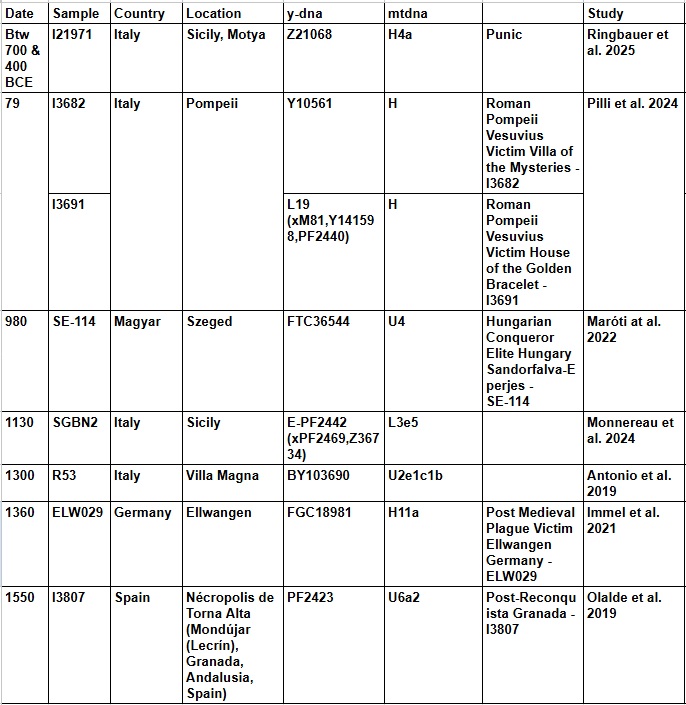
Explanation for the Presence of These Lineages
1. Phoenician/Punic Colonization and the Ancient Mediterranean
- Sicily, Motya (I21971, Z21068, Punic era):
Motya was a Phoenician and later Carthaginian colony. The Carthaginians originated from North Africa (modern Tunisia), where E1b1b haplogroups—including E-PF2431 and its sister branches—were present among Berber populations. The presence of Z21068 in Motya reflects the arrival of North African lineages in Sicily via Phoenician/Punic colonization.
2. The Roman Empire and Mediterranean Mobility
- Pompeii (I3682, Y10561 & I3691, L19):
The Roman Empire was a crossroads of populations. E1b1b haplogroups were present, likely introduced by slaves, soldiers, merchants, or migrants from North Africa, the Near East, or the Mediterranean basin. This explains the presence of these lineages in Pompeii.
3. Medieval Migrations and Conquests
- Medieval Sicily (SGBN2, E-PF2442):
After antiquity, Sicily was conquered by Arabs and Berbers in the Middle Ages. These conquests brought new waves of E1b1b lineages, including E-PF2442, descendant of PF2431. - Hungary (SE-114, FTC36544, Magyar conquest):
The Magyar conquest of Hungary involved groups of diverse origins, including some from the Mediterranean or Caucasus regions, where E1b1b was present. The presence of this lineage among the Magyar elite illustrates this diversity.
4. Medieval and Modern Europe
- Germany (ELW029, FGC18981, 1360):
The presence of this lineage in medieval Germany can be explained by population movements, trade, military mobility, or the slave trade. Central and Western Europe have always been traversed by human flows from the south and east. - Italy (R53, BY103690, 1300):
The Italian peninsula experienced continuous genetic mixing since antiquity, with North African, Eastern, and European contributions.
5. Post-Reconquista Spain (I3807, PF2423, 1550)
- After the Reconquista, many Moriscos (Muslims of North African, often Berber, descent) remained in Spain, especially in Andalusia. The presence of PF2423, a branch of PF2431, is consistent with this heritage.
Summary
- E-PF2431 and its close branches are typical lineages of ancient North Africa, particularly among Berbers.
- Their presence in Sicily, Italy, Spain, Hungary, and Germany is explained by the complex history of the Mediterranean and Europe:
- Phoenician/Punic colonization
- The Roman Empire
- Arab/Berber conquests
- Medieval migrations (Magyars, trade, slavery)
- Post-medieval mixing (Moriscos, trade, wars)
- These lineages are evidence of the deep genetic and historical connections between North Africa and the Mediterranean and Central Europe.
The presence of these haplogroups in the mentioned locations reflects episodes of expansion, migration, and Mediterranean mixing, with a strong North African (Berber) component that has left a lasting genetic legacy across Southern Europe and beyond.
